A day involving ferries, ports or a long crossing can make ordinary meals surprisingly awkward. The useful preparation is often simple: know when food will be available, what you can carry and which choices fit your needs. An elaborate diet plan is less useful if it depends on a café that closes before boarding.
This guide provides a practical planning sheet for travellers. It does not describe a particular operator’s services or replace instructions from a vessel’s crew. Check current arrangements for the crossing you have booked.
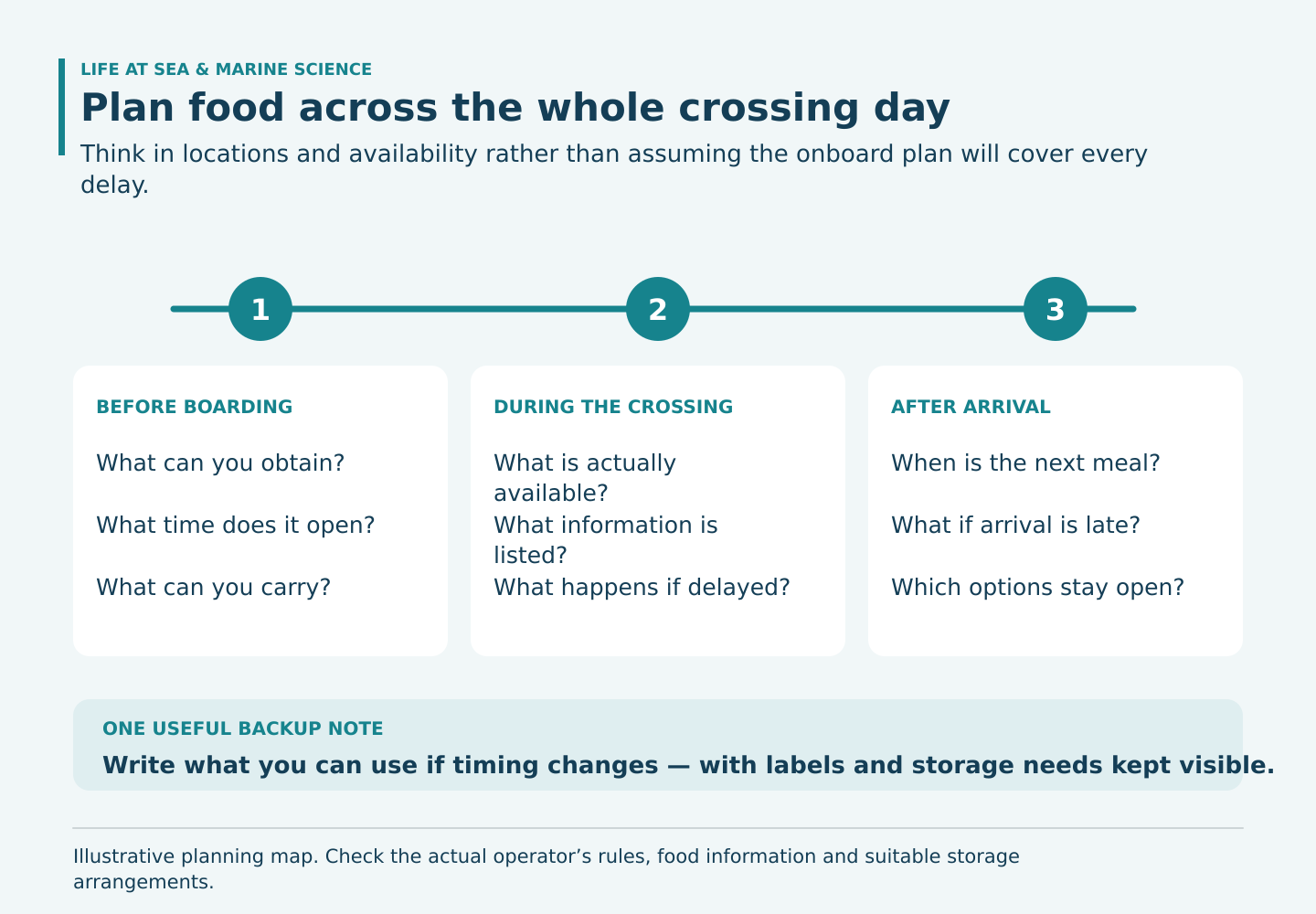
Plan around the whole journey
Start with departure from home, not departure of the ship. Include travel to the terminal, check-in, waiting, the crossing and the onward journey. These stages may cover more meal opportunities than the sailing time suggests.
Write down what is confirmed and what is assumed. “Ticket includes dinner” is different from “there is probably a restaurant.” If a meal, ingredient or facility matters, obtain the information before travelling. Keep the answer with the booking so it is easy to find later.
Make an availability map
| Stage | Confirmed option | Question to resolve |
|---|---|---|
| Journey to port | Breakfast before leaving. | Is there time for a planned stop? |
| Terminal wait | One shop shown on the terminal plan. | Will it be open at check-in? |
| Crossing | A dining option listed on the booking. | What are its hours and available ingredients? |
| Arrival | Onward transport booked. | When is the next realistic meal opportunity? |
The example contains no real timetable. Its purpose is to make assumptions visible. Replace each line with information about your own journey, and avoid relying on an old photograph of a menu as proof of what will be served.
Think about meals before individual nutrients
The NHS Eatwell Guide describes an overall balance across food groups and notes that this balance need not be achieved at every meal. That is a helpful perspective for a disrupted travel day: consider the broader pattern rather than expecting one terminal snack to meet every nutritional aim.
List a few familiar options you would be content to eat. Depending on availability and your dietary needs, that might include a meal built around a starchy food, a protein source and fruit or vegetables. Treat these as planning categories, not a prescribed menu or a personal nutrient target.
Check the carrying and storage arrangements
Before packing food, check the operator’s rules and the requirements at your destination. Also consider whether an item needs refrigeration, how it will be carried and when it will be eaten. Do not assume a cabin has a suitable refrigerator simply because a room photograph shows a small cupboard.
The CDC’s food and drink advice for travellers discusses food handling, temperature and safe water in travel settings. It highlights keeping hot foods hot and cold foods cold, and checking the integrity of factory-sealed items. Use appropriate food-safety guidance instead of improvising storage conditions for a long journey.
Preserve labels when information matters
A small unlabelled bag may save space but remove the ingredient and storage information you need. Keep the original packaging when practical, or retain a clear record that stays with the item. This is especially useful when several people share food or when you need to ask a question about its contents.
For allergies or other medically important dietary requirements, discuss the arrangements with the operator in advance and follow your established care plan. A general menu description cannot answer every ingredient or cross-contact question.
A fictional delay scenario
Imagine a traveller whose afternoon crossing is delayed. Their original plan assumed lunch at the terminal and dinner after arrival. They checked that the terminal outlet was open, carried an appropriate labelled snack and saved the operator’s dining information. The delay still changes the day, but it does not require inventing a plan from nothing.
Now imagine the same traveller packed a meal requiring refrigeration without confirming how to keep it chilled. More food would not necessarily mean better preparation. The relevant question is whether the plan remains practical and safe under the actual conditions.
This example is about organisation. It does not suggest that a snack replaces an ordinary meal, or that any one travel-food choice suits everyone.
Keep a short note after the journey
If you travel the route repeatedly, record what was useful: where food was available, which assumptions proved wrong and what you would do differently next time. Add the date because services and menus can change.
A useful note might say, “Had less time between disembarking and the train than expected; plan the next meal before boarding.” Avoid turning one experience into a permanent claim about an operator. Conditions on another sailing may differ.
Do not let a supplement solve an undefined problem
Travel can expose you to advertisements for energy, recovery or protein products. Before considering one, identify the practical issue. Is a meal unavailable? Is the label difficult to understand? Are you trying to meet a dietary plan already agreed with a professional? These questions require different information.
A marine-themed package may look appropriate for a sea journey, but the imagery does not establish a nutritional need. Ingredient identity and evidence matter more than whether the branding includes a ship, wave or coastal landscape.
Leave with a plan that fits on one page
If several people are travelling together, agree who is checking each uncertain detail. One person can confirm opening hours while another checks the booking’s meal arrangements. Keep the answers together so everyone uses the same information, rather than relying on separate assumptions discovered only after arriving at the port.
- Map the entire travel day and likely meal opportunities.
- Separate confirmed services from assumptions.
- Check carrying, storage and destination requirements.
- Keep important ingredient information available.
- Record one useful lesson for the next trip.
The best result is a plan you can use while travelling, not a complicated document you leave at home. Clear information about timing, availability and ingredients provides a practical starting point for later questions about protein foods and marine-derived nutrition.